The Third Annual Conference on Language Modeling gets underway tomorrow in San Francisco, California. We’re excited to share the works that will be presented by the group and our collaborating authors. You can find links and poster times for our COLM 2026 papers below!
Learning Human-Perceived Fakeness in AI-Generated Videos via Multimodal LLMs
Thursday, October 8, 16:40-18:30 — Poster Session 6
Can humans identify AI-generated (fake) videos and provide grounded reasons? This paper introduces DeeptraceReward, the first fine-grained, spatially- and temporally-aware benchmark that annotates human-perceived fake traces for video generation reward. By foregrounding human-perceived deepfake traces, DeeptraceReward provides a rigorous testbed and training signal for socially aware and trustworthy video generation.
Xingyu Fu and Siyi Liu and Yinuo Xu and Pan Lu and Guangqiuse Hu and Tianbo Yang and Taran Anantasagar and Christopher Shen and Yikai Mao and Yuanzhe Liu and Keyush Shah and Chung Un Lee and Yejin Choi and James Zou and Dan Roth and Chris Callison-Burch, Learning Human-Perceived Fakeness in AI-Generated Videos via Multimodal LLMs COLM (2026)
SAKE: Structured Agentic Knowledge Extrapolation for Complex LLM Reasoning via Reinforcement Learning
Tuesday, October 6, 11:00-13:00 — Poster Session 1
Knowledge extrapolation is the process of inferring novel information by combining and extending existing knowledge that is explicitly available. This paper proposes SAKE (Structured Agentic Knowledge Extrapolation), a RL powered agentic framework that trains LLMs to autonomously retrieve and extrapolate structured knowledge through tool-augmented reinforcement learning. The results demonstrate that associative reasoning over incomplete structured knowledge does not require large models with complex, multi-step prompting, but can be learned end-to-end by small, open-weight models through reinforcement learning with the right tools and training signal.
Routesplain: Towards Faithful and Intervenable Routing for Software-related Tasks
Thursday, October 8, 11:00-13:00 — Poster Session 5
This paper introduces Routesplain, the first LLM router for software-related tasks, including multilingual code generation and repair, input/output prediction, and computer science QA. Unlike existing routing approaches, Routesplain first extracts human-interpretable concepts from each query (e.g., task, domain, reasoning complexity) and only routes based on these concepts, thereby providing intelligible, faithful rationales.
On July 2nd, I traveled to San Diego for ACL 2026. I presented two works, our TACL paper on the MoNaCo benchmark and a joint work, led by Dhruv Madhwal (ASU) and David Zhang (UPenn), on a new method for validating LLM factual consistency through Decomposed Prompting. You can also check out their abstracts elsewhere on the CCG blog (thanks, Jen!).
This conference saw slightly fewer attendees than past conferences (~3.5K), mostly due to the clash with July 4th celebration of 250 years, and the proximity to ICML. Still, there were quite a few thought provoking talks during the conference. I particularly enjoyed Noah Smith’s talk at “The Big Picture Workshop“, on how to do impactful research in a fast-moving field like AI. You can actually watch his talk for free using this link.
From Noah A. Smith, “Where it Hurts: Finding Durable Questions While Moving Fast”
Another interesting talk was Philip Resnik’s keynote, which can be found here. The talk raises questions on the role of *ACL conferences relative to AI and Computational Linguistics. It is a thought provoking talk that raises many questions on the future of *ACL conferences and their place within the broader AI research community.
Below, are three of the papers which I found relevant to my research:
ScheMatiQ is an interactive LLM-based system that helps researchers transform natural language research questions and document collections into structured, evidence-backed datasets by automatically discovering task-specific schemas and extracting grounded data. Its key contribution is treating schema discovery as part of the research workflow, allowing expert users to iteratively refine both the schema and extracted data instead of requiring a predefined ontology. Experiments with legal and biomedical research tasks show that ScheMatiQ produces schemas and structured outputs that closely align with expert annotations while substantially reducing manual data curation effort. Overall, this work demonstrates how combining LLM-assisted schema induction with human oversight can make structured evidence extraction more efficient, flexible, and accessible for open-ended scientific research.
OctoTools is a prompt-based multi-agent system that enables LLMs to solve complex reasoning tasks by orchestrating external tools through hierarchical planning. Its key contribution is a modular architecture based on standardized “Tool Cards”, allowing new tools to be integrated without retraining while separating high-level task planning from low-level tool execution. Across 16 benchmarks (MMLU-Pro, MedQA, GAIA-Text, etc.), OctoTools improves average accuracy by 9.3% over GPT-4o and outperforms prior agent frameworks such as AutoGen, LangChain, and GPT-Functions under comparable tool settings. My main takeaway is the introduction of Tool Cards, as another layer for tool-using agentic systems, very similar to Anthropic’s “skills”. The usage of tool cards encapsulates heterogeneous tools while providing the planner agent with metadata such as input-output formats, usage constraints, and best practices for ideal use cases. This standardized approach enables an easy extension of the agentic system by adding new tools and replacing or expanding existing ones.
As its name indicates, this work aims to use LLMs to assist public health experts in uncovering new opportunities for suicide prevention. The methods are designed to assist human experts, not replace them, with a strong emphasis on expert oversight. They use a public dataset, The National Violent Death Reporting System (NVDRS) with 270K suicide cases labeled with structured variables and narrative text describing the death. The annotation of such data is emotionally taxing and prone to inconsistencies. To address these challenges, they incorporate LLMs as peer validators for NVDRS annotations. They instruct LLMs to predict the label for a variable given the NVDRS codebook in the prompt and find that LLMs can match existing data annotations 85% of the time across 50 variables. My main takeaway from this work is how LLMs can be effectively integrated in the annotation pipeline in domains outside of code, Wikipedia or financial workflows. There are many data-intensive jobs that could greatly benefit from AI systems, and gauging the performance of current LLMs on these new domains is clearly important.
Tomer at his presentation.
II. From Alon Jacoby:
As ACL concluded this year, I wanted to share a few impressions based on the papers I saw and conversations at the conference.
These topics are close to my interests, especially principled agent design and reliable evaluation, so this is not a representative survey. Still, a few trends stood out.
ACL may have suffered from unfortunate timing, with ICML nearby and the July 4th holiday competing for attention. The conference was active, but attendance and poster interaction seemed lower than they might otherwise have been.
The poster sessions also reflected the growing number of papers applying LLM agents to specific domains, especially biology and medicine. This is valuable, but it raises questions about ACL’s role as the field expands, echoing Philip Resnik’s discussion of ACL’s place in the broader research community.
At the same time, traditional computational linguistics remains present. I saw work on syntax, multilinguality, and linguistic structure, including a paper using syntactic information to improve Coptic translation through in-context learning. The shift is therefore not a replacement of computational linguistics by LLM applications, but in the balance among computational linguistics, general-purpose LLM research, and domain-specific work.
This paper searches over multi-agent architectures using a context-free grammar rather than unconstrained code or natural-language generation. The grammar specifies component types and valid compositions, for example allowing a multi-input, single-output component such as a voter or consensus builder to connect to other compatible components.
This separates the question of which architectures are admissible, from how to search among them. It also encodes structural knowledge directly instead of asking an LLM to “rediscover” it.
The search itself is simple: architectures are sampled from the grammar, with forced sampling used to ensure that less frequently encountered components are also explored, and each new architecture is evaluated on a validation set. The final procedure does not use architecture performance to adapt the sampling distribution, although the authors report experimenting with more sophisticated strategies such as Thompson sampling and Monte Carlo Tree Search without seeing gains. Still, I think an interesting direction would be to make production probabilities explicitly task-dependent, for example by learning which components tend to be useful for particular classes of tasks.
This paper addresses benchmark contamination, where a model’s performance may be inflated because it encountered the test data during training. The authors perturb inputs in embedding space so that a contaminated model behaves more like a less-contaminated reference model, while leaving the discrete input text unchanged.
This avoids the obvious problem with paraphrasing or rewriting questions, where changing the text may change the task. The authors provide empirical evidence that their perturbations largely preserve the original input, including high similarity between original and perturbed embeddings and relatively small utility degradation on clean examples. They also explicitly acknowledge, however, that they do not have a formal guarantee that semantics or difficulty are preserved for every input.
I think this remains an important point. Closeness in embedding space is not obviously equivalent to equivalence in effective task difficulty, so it is difficult to completely rule out the possibility that some of the apparent decontamination comes from a more generic change in the model’s ability to solve the example. Still, the empirical results are promising under the paper’s evaluation metrics: the method brings contaminated-model behaviour substantially closer to that of the reference model while generally avoiding large degradation on clean data.
This paper asks whether strong performance on one OOD test set predicts strong performance on another. Raw OOD correlations are confounded by general model quality: later or better checkpoints may simply perform better on everything.
To address this, the authors regress each OOD test-set performance on in-domain performance and correlate the resulting residuals across OOD datasets. These residuals capture whether a checkpoint performs better or worse OOD than its in-domain performance would predict.
The resulting relationships are unstable. Two OOD datasets can correlate positively for one model family and negatively for another. Thus, a checkpoint that appears to generalize unusually well under one distribution may not do so under another, and more generally conclusions about OOD generalization can depend substantially on the particular test distribution.
This is a useful reminder that “OOD generalization” is not a single model property, but rather that it depends on the distribution shift being tested. More generally, benchmark scores are often treated as measurements of broad abilities such as reasoning, robustness, or generalization. These results suggest we should be cautious about assuming that different operationalizations measure the same underlying property.
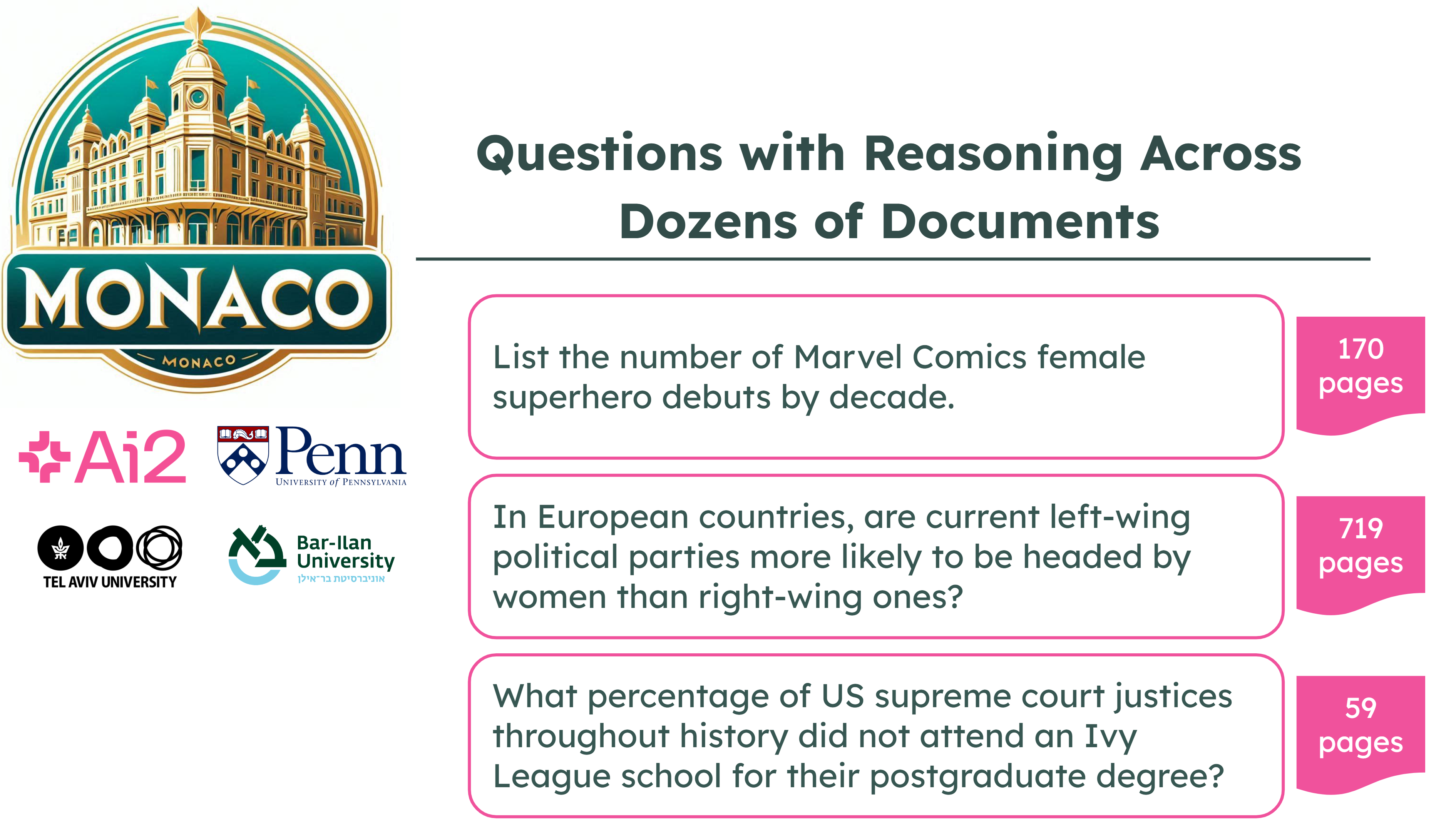
We introduce MoNaCo, a benchmark of More Natural and Complex questions to evaluate the question-answering (QA) skills of language models. MoNaCo contains 1,315 time-consuming questions whose solutions involve combining and reasoning over information spanning across dozens of Wikipedia tables and passages.
Large language models (LLMs) are emerging as the go-to tool for answering questions and surfacing hard-to-find information. While LLMs (and LLM-powered applications such as Deep Research) hold great promise in solving problems that require combining knowledge from hundreds of sources, such problems are poorly represented in most model evaluation benchmarks. Existing QA benchmarks rarely feature realistic questions that are both fact-reliant and genuinely time-intensive for humans to answer. Instead, most benchmark questions are too simplistic, requiring only a handful of evidence documents, while the more complex QA benchmarks are typically machine-generated—which may result in contrived and unnatural questions.
MoNaCo addresses this gap, presenting realistic questions whose solution spans up to hundreds of documents. Furthermore, it reveals key limitations in the question-answering abilities of frontier LLMs.
In our experiments, we tested 15 frontier LLMs on MoNaCo, including GPT-5, o3, Claude Opus 4, Gemini 2.5 Pro, and Deepseek-R1. All models struggled, with the top-performing LLM, o3, reaching an F1 score of 61.2% while answering only 38.7% of examples with a perfect score.
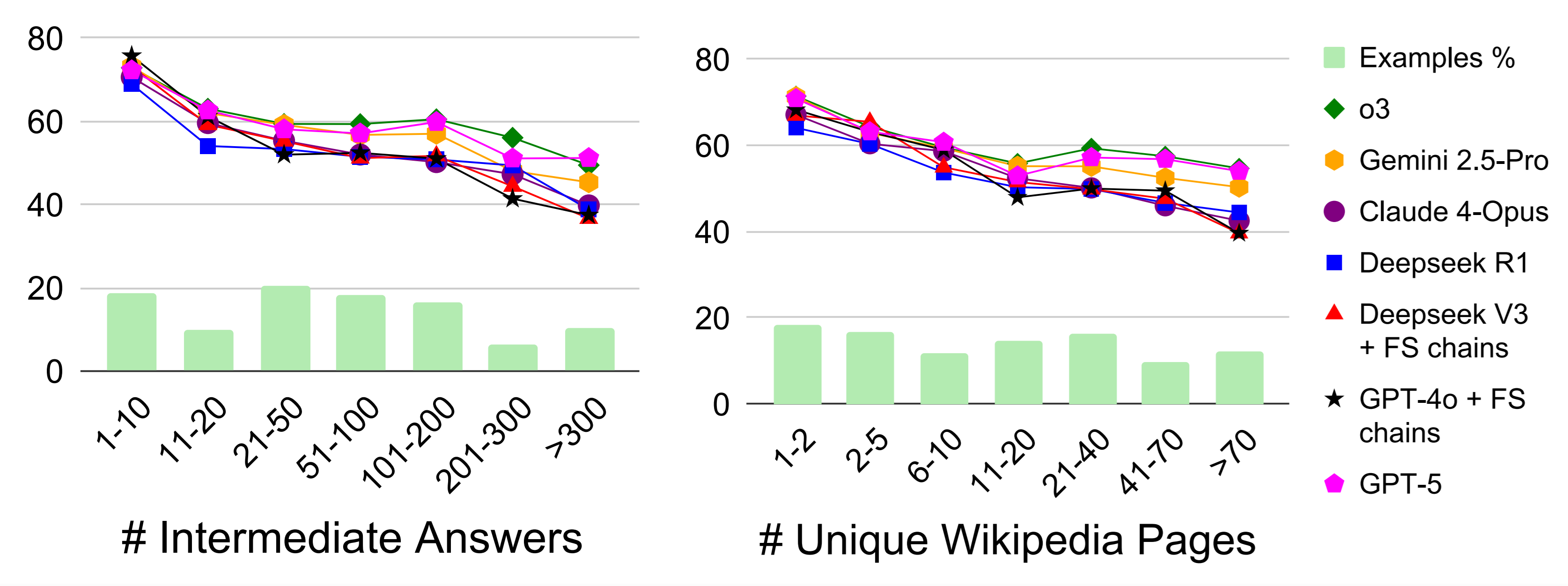
We also observe that as solutions to questions entail reasoning over more intermediate answers or require more evidence sources, model performance decreases substantially.
About the MoNaCo Benchmark
We created MoNaCo as a QA benchmark with questions that are:
Realistic, reflecting the information-seeking goals of real-world users
Time-consuming, with questions that cannot be answered without potentially hundreds of intermediate facts
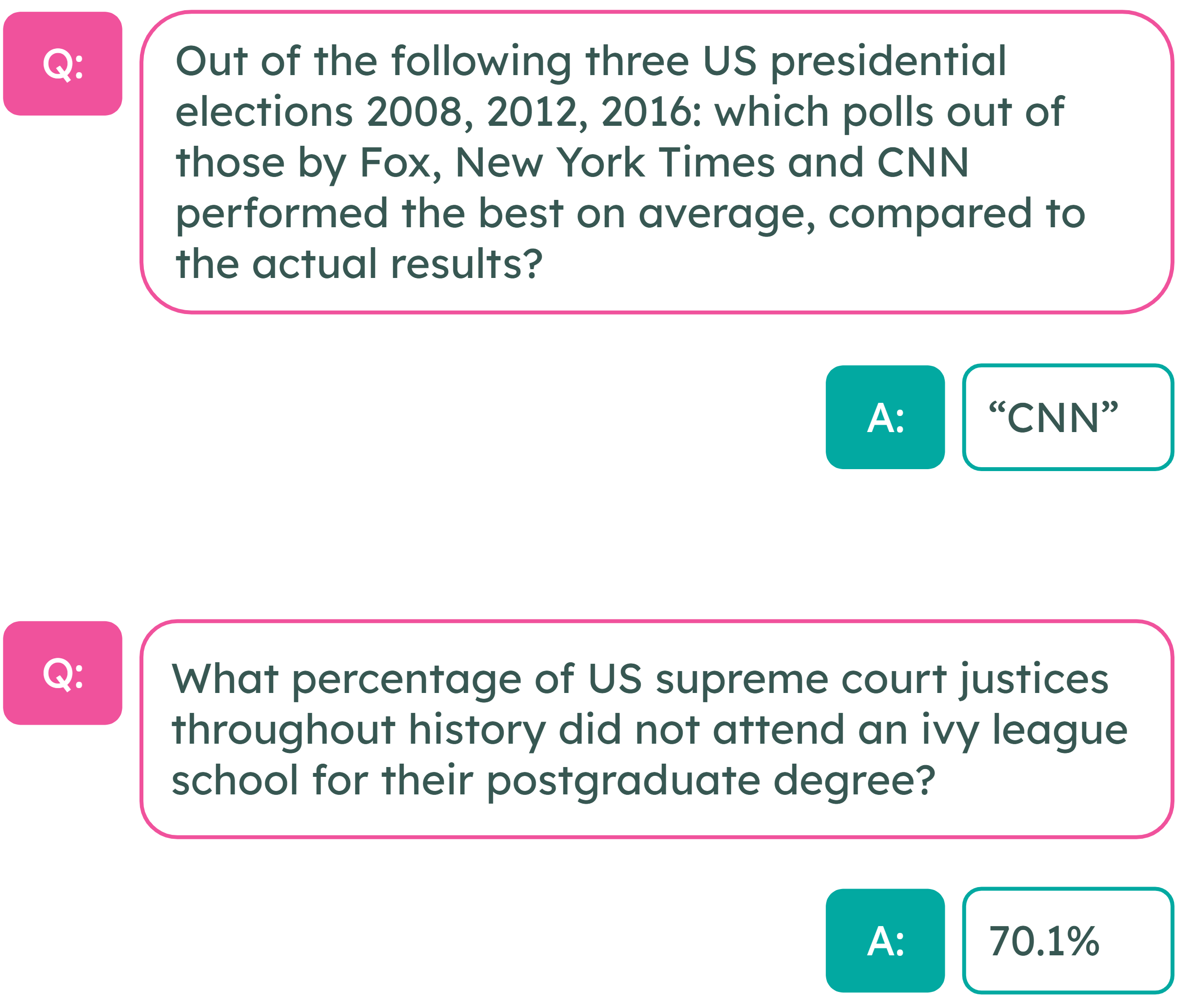
For example, while the two MoNaCo questions below have succinct answers, they both require dozens of fact-finding steps:
Overall, MoNaCo has 1,315 questions whose solutions involve many intermediate steps that span across dozens, and at times hundreds, of evidence documents. Compared to traditional QA benchmarks, the scope of MoNaCo questions is much broader. To solve them, models must be proficient at decomposing complex queries, locating hundreds of pieces of information, and reasoning, combining, and aggregating this data effectively.
MoNaCo’s breadth and depth makes it ideal as an LLM benchmark for at least five different settings:
Evaluating models’ parametric knowledge and reasoning
Measuring complex reasoning over long contexts, where all of the evidence docs are provided in the context
Multi-document retrieval performance
End-to-end retrieval-augmented generation (RAG)
Training Deep Research-like systems, using the gold standard reasoning chains
Human-Annotated Reasoning Chains
Unlike other QA benchmarks, all questions in MoNaCo come with gold-standard, human-annotated reasoning chains. Namely, for each question, we provide all the intermediate steps for its solution, as well as the answers and supporting evidence documents.
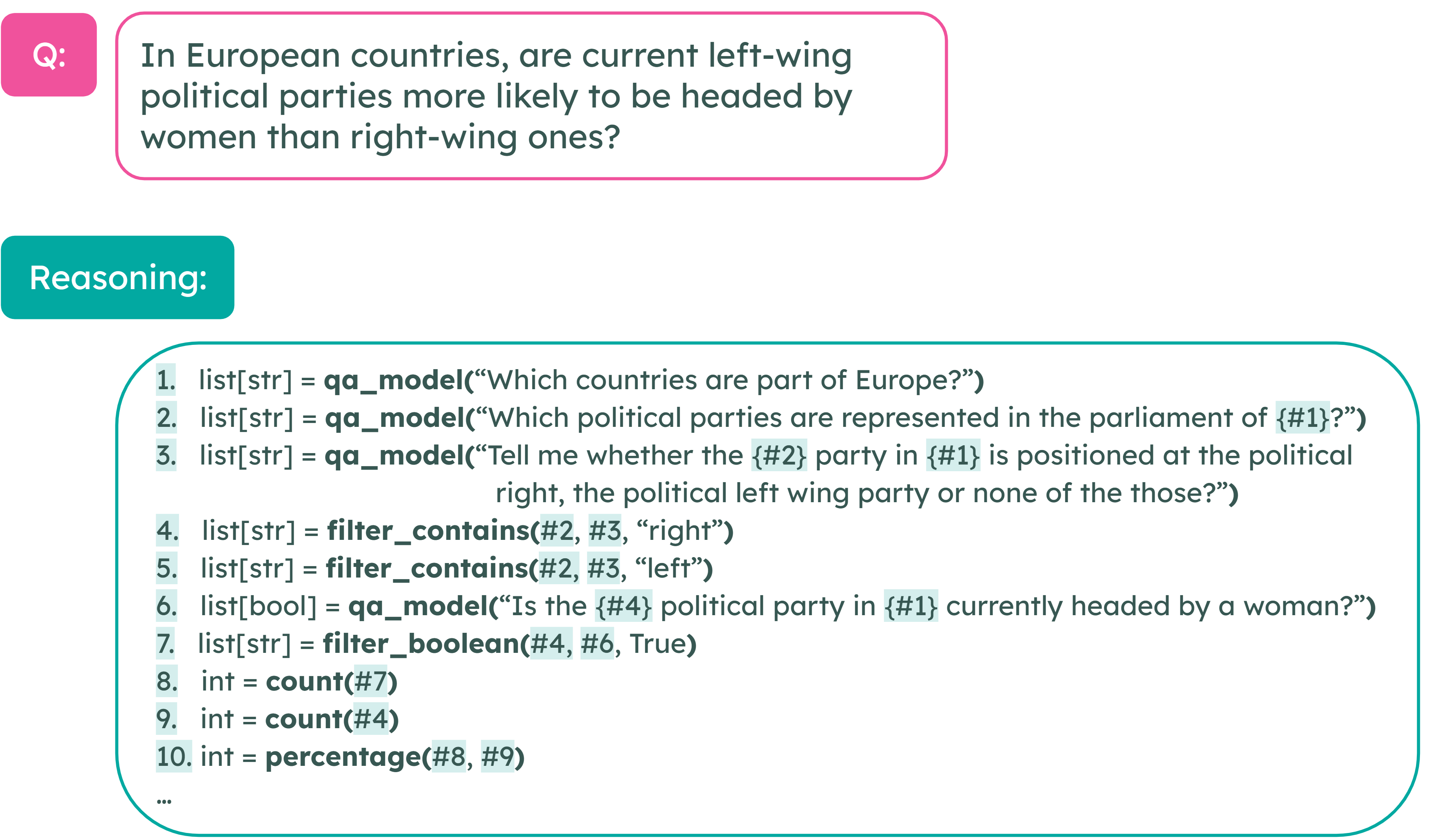
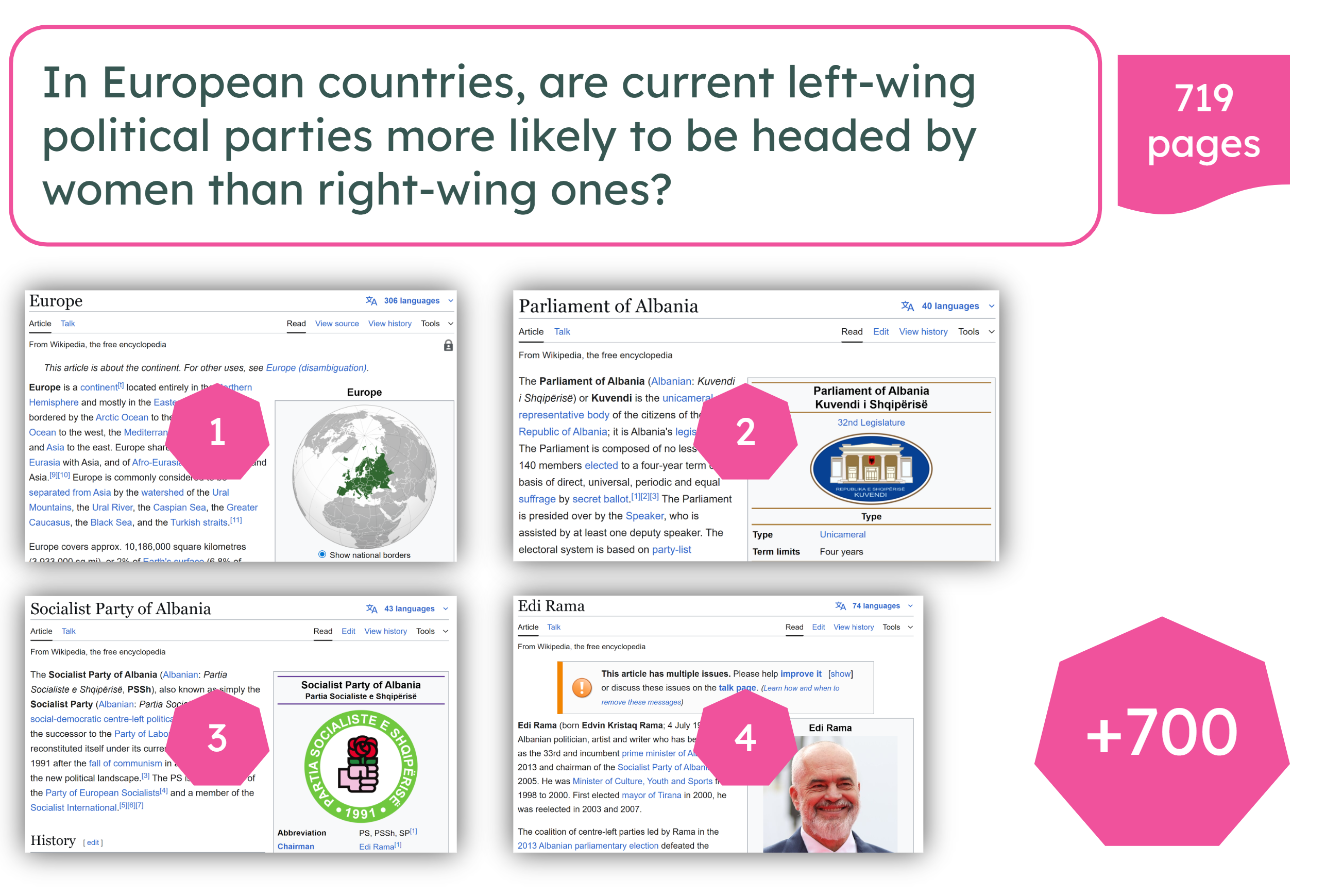
Reasoning chains are expressed as a series of decomposition steps. In the figure below, we see part of the decomposition of an example question: “In European countries, are current left-wing political parties more likely to be headed by women than right-wing ones?” Each step is either an intermediate question (qa_model) or a Python function representing a query operation (filter, count). For question steps, we provide human-annotated answers and supporting sentences/tables from Wikipedia, while for query operation steps, we provide their full execution results.
Note that the reasoning chain of the example question would be extremely time-consuming for any person to follow. Answering this question entails reviewing all political parties in each European country to note their affiliation and the leader’s gender, drawing on the equivalent of 719 Wiki pages.
Data Collection and Composition
Collecting realistic and many-step questions “in the wild” for a benchmark like MoNaCo is hard. Users tend to shy away from entering such queries into search engines, and recording them from user-AI interactions—most of which are private—poses added challenges.
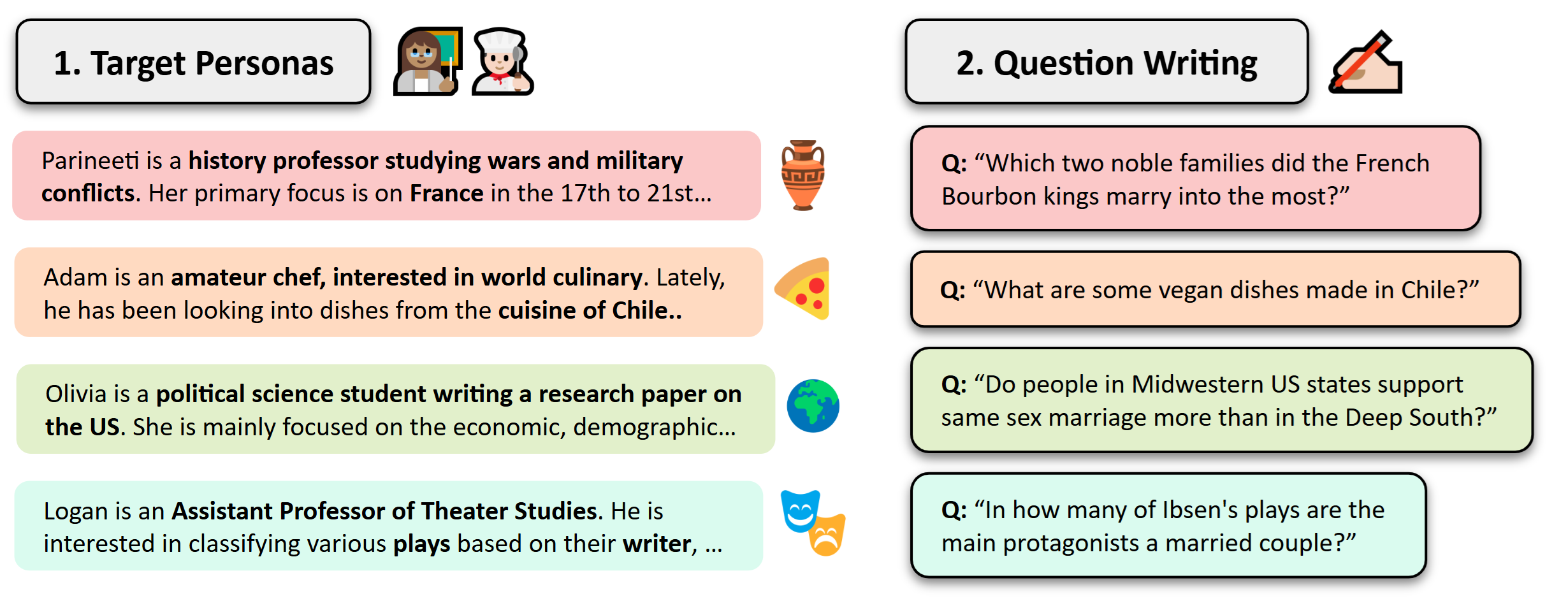
For MoNaCo, we relied on annotators to write questions that reflect real-world users’ information-seeking goals. Specifically, we asked Amazon Mechanical Turk workers to write questions that would interest a particular target persona. By priming workers to assume a specific persona and not use pre-defined templates, we encouraged these workers to come up with realistic questions—helping diversify our data.
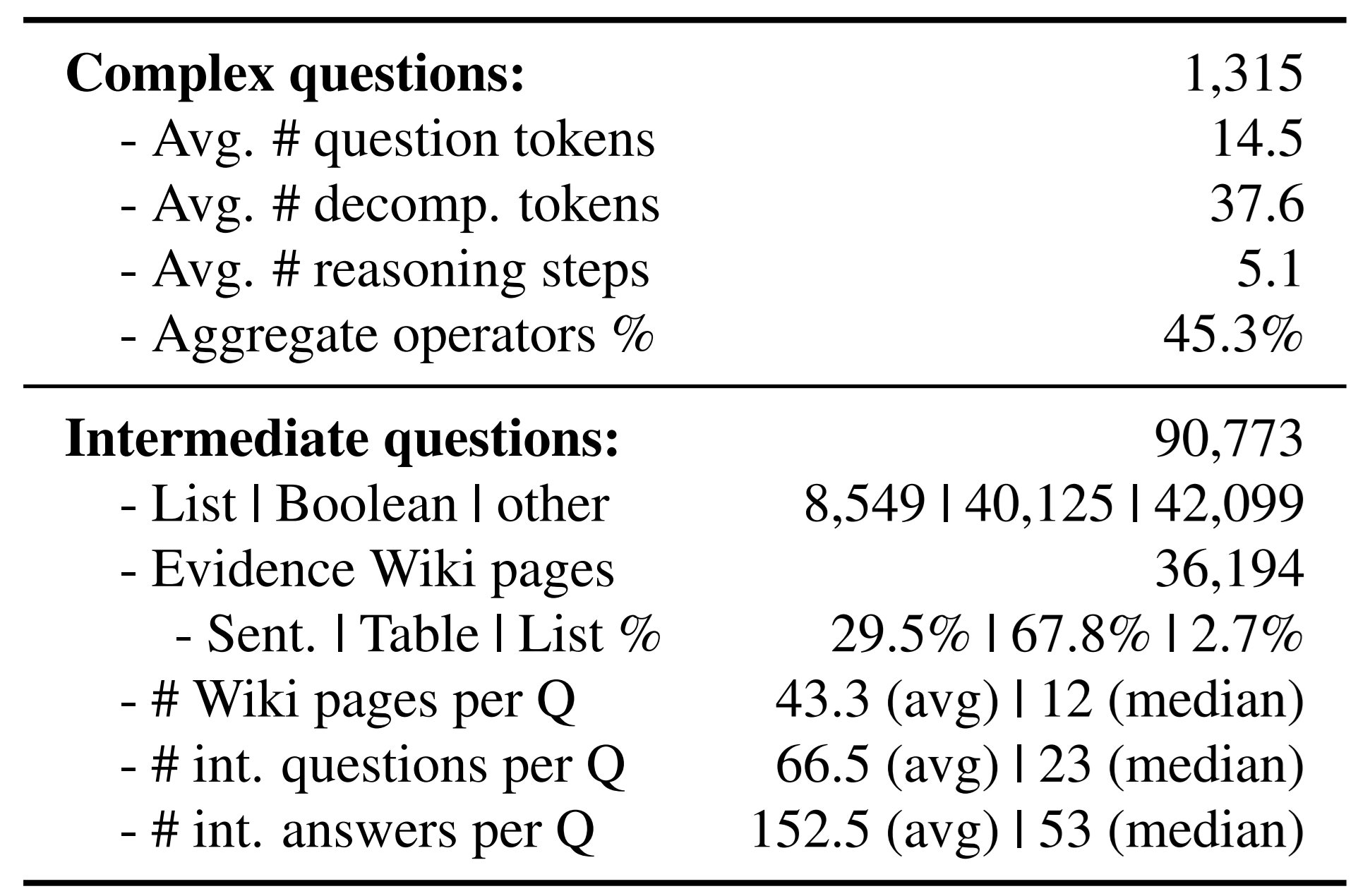
In total, we collected 1,315 complex questions, along with their intermediate steps, answers, and supporting evidence. This data includes over 90K intermediate questions with 8.5K list questions—each list having 16.2 answers on average and a median of 5 answers. For comparison, the list QA benchmarks QAMPARI and QUEST have 2K and 3.4K manually-written questions, making MoNaCo the largest benchmark of human-written list questions.
MoNaCo also contains 40K Boolean (yes/no) questions—much more than past benchmarks such as BoolQ and StrategyQA, which have 15.9K and 2.8K questions, respectively.
The intermediate answers in MoNaCo are supported by evidence from 36K distinct Wikipedia pages, with each question supported by 43.3 documents on average (median of 12). Documents are either a sentence (29.5%), a table (67.8%), or a list (2.7%). This underscores the multimodal nature of MoNaCo, as answering its questions requires reasoning across both paragraphs and tables.
Observations on Multi-Document RAG
When evaluating models in a retrieval setting, we observe two interesting phenomena.
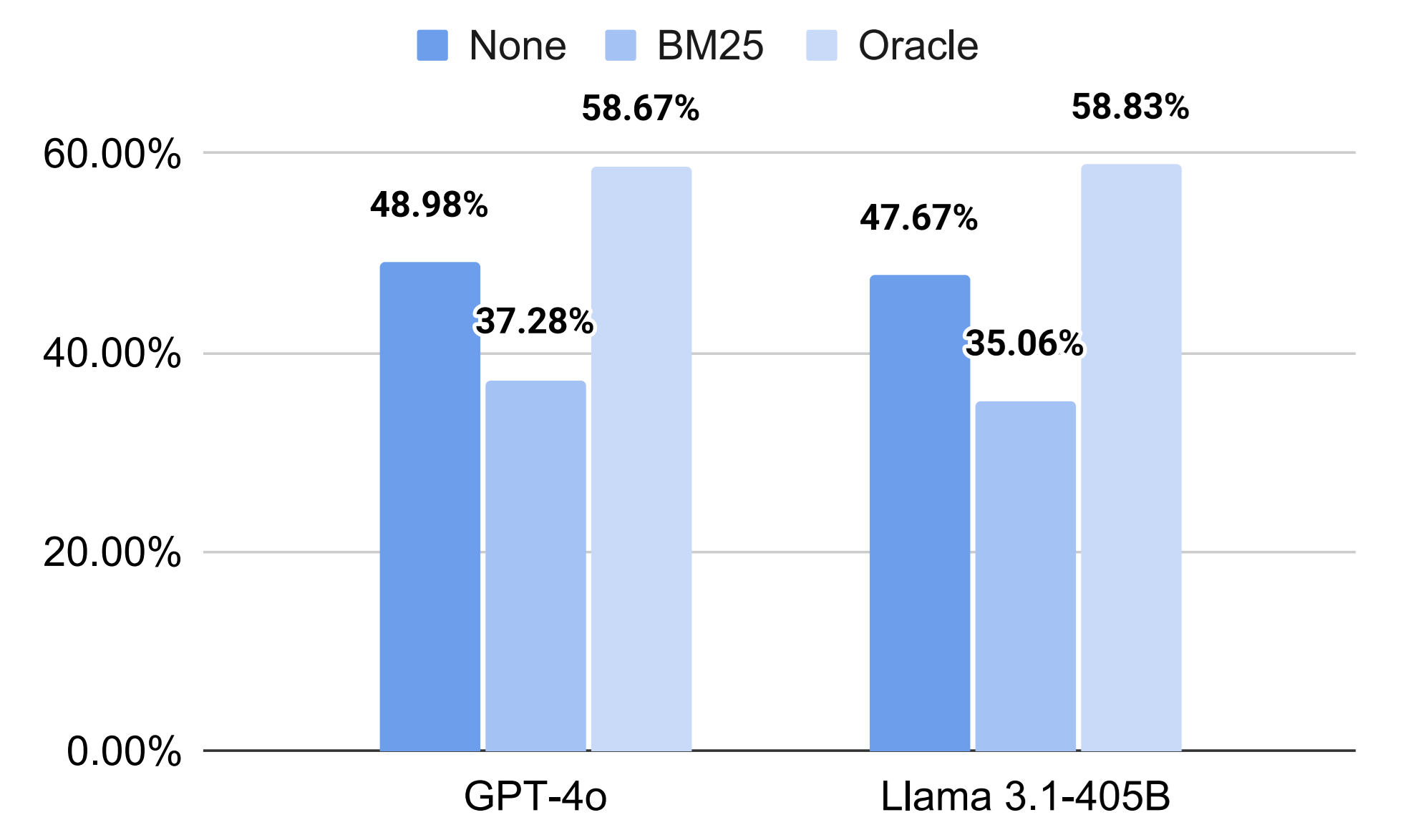
First, in an “Oracle retrieval” setting, where all the gold evidence documents are provided to the model as input, models experience a 10-point improvement compared to the closed-book setting (no evidence provided). Nevertheless, these models reach only 58.7% F1—far from a perfect score. This indicates that even with all of the relevant knowledge provided, models still struggle with the long-context reasoning that MoNaCo questions entail.
Second, in an “end-to-end RAG” setting (with a BM25 retriever), models experience a sharp drop in performance compared to the closed-book setting. While retrieved documents may only be partially relevant, our RAG prompt explicitly instructs LLMs to ignore the documents in such cases. This lack of “retrieval robustness” has been observed in weaker models, but we find that the limitation persists even in much stronger LLMs.
Conclusion
MoNaCo can evaluate how well LLMs answer questions that require retrieving and reasoning over dozens—or even hundreds—of pieces of evidence. We hope that our work advances research on more factual and attributable AI systems.
We invite researchers to evaluate the capabilities of LLMs and retrievers on MoNaCo and to provide their feedback. Visit our website and read the paper to learn more about the MoNaCo benchmark, which is available on HuggingFace.
Decomposed Prompting Does Not Fix Knowledge Gaps, But Helps Models Say “I Don’t Know” (ACL Findings)
This paper examines how different prompting strategies influence the reliability of large language models (LLMs) in closed-book question answering, with a focus on their tendency to produce confident hallucinations. It compares model responses to direct questions with those generated using question decomposition: a multi-step reasoning plan for solving the original question. The results show that discrepancies between these two prompting approaches are highly indicative of hallucinations, offering a stronger signal than prior methods such as self-consistency.
Toward Robust Evaluation for Multilingual Grammatical Error Correction: Can Large Language Models Replace Human References? (ACL)
Prior research has shown that using a <i>closest-gold reference</i> – i.e., a human reference generated with respect to the system output rather than the original text – yields more accurate performance estimates. This paper introduces <i>an automated method for generating closest-gold references</i> by prompting a large language model (LLM) with system outputs. We find that performance scores computed using automatic closest-gold references correlate well with human closest-golds, whereas standard reference-based evaluations show weak or no correlation. Building on this insight, we use both fixed human references and closest-gold references generated by Claude and Llama to compare the performance of supervised models and GPT-4 across 14 benchmarks spanning 12 languages.
Monday, July 6, 09:00-10:30 — Grand Hall & Coronado, Poster Session D
MoNaCo: More Natural and Complex Questions for Reasoning Across Dozens of Documents (TACL, presented at ACL)
The landscape of AI-powered web search is being transformed: evolving from static large language models to LLM-powered “agents” which surface hard-to-find information through multiple rounds of reasoning and retrieval. Evaluating these agents requires measuring their ability to formulate and execute long-horizon plans that demand integrating information from dozens or even hundreds of web pages. Yet existing benchmarks are largely limited to tasks involving only a handful of sources, failing to capture the recall-intensive challenges found in many real-world applications. This paper introduces MoNaCo, the first benchmark that evaluates AI agents’ ability to answer long-horizon questions that span dozens—and in some cases hundreds—of web pages. MoNaCo consists of 1,315 human-authored questions, each paired with ground-truth answers, supporting evidence, and gold-standard reasoning chains. We evaluate 15 frontier LLMs and identify substantial performance gaps: the top-performing model, o3, achieves a perfect score on just 38.7% of the benchmark. Using MoNaCo, we show that deep reasoning across large document collections remains an open challenge for current AI agents, and discuss promising directions for bridging this gap.
REaR: Retrieve, Expand and Refine for Effective Multitable Retrieval (ACL)
This paper introduces REAR (Retrieve, Expand and Refine), a three-stage, LLM-free framework for efficient, high-fidelity multi-table retrieval. REAR (i) retrieves query-aligned tables, (ii) expands these with structurally joinable tables via fast, precomputed column-embedding comparisons, and (iii) refines them by pruning noisy or weakly related candidates.Despite being LLM-free, it delivers performance competitive with state-of-the-art LLM-augmented retrieval systems while achieving much lower latency and cost.
Is Code Better Than Language for Algorithmic Reasoning? (ICML)
This paper provides a methodology to compare two types of problem solving strategies with LLMs, 1) directly use CoT reasoning 2) call a tool (e.g. external runtime) by writing a piece of code. The methodology shows how tool calling is dominant through a theoretical perspective, and backs up the intuition with experimental results.
A selection of further papers co-authored by Dan Roth
ToolScope: Enhancing LLM Agent Tool Use through Tool Merging and Context-Aware Filtering (ACL)
Large language model (LLM) agents rely on external tools to solve complex tasks, but real-world toolsets often contain noisy and overlapping tool options. This paper introduces ToolScope, which analyzes external toolsets to reduce redundancy and to select the most relevant tools for each query.
SPENCE: A Syntactic Probe for Detecting Contamination in NL2SQL Benchmarks (ACL)
Large language models (LLMs) have achieved strong performance on natural language to SQL (NL2SQL) benchmarks, yet their reported accuracy may be inflated by contamination from benchmark queries or structurally similar patterns seen during training. We introduce SPENCE (Syntactic Probing and Evaluation of NL2SQL Contamination Effects), a controlled syntactic probing framework for detecting and quantifying such contamination.
When Vision-Language Models Judge Without Seeing: Exposing Informativeness Bias (ACL)
This paper addresses a fundamental flaw in current VLM-as-a-Judge systems, namely informativeness bias, the tendency to blindly favor more informative answers while giving little attention to the image. To improve reliability, we propose BIRCH, which compares candidate answers against a self-generated anchor that corrects or verifies image details, shifting the judge’s focus back to image content and balancing informativeness with correctness.
JTPRO: A Joint Tool–Prompt Reflective Optimization Framework for Language Agents (ACL Findings)
Large language model (LLM) agents augmented with external tools often struggle as number of tools grow large and become domain-specific. This paper introduces Joint Tool-Prompt Reflective Optimization (JTPRO), a framework for improving tool-calling reliability in trace-supervised settings by iteratively using rollout-driven reflection to co-optimize global instructions and per-tool schema/argument descriptions for accurate tool selection and argument instantiation in large tool inventories.
MT-OSC: Path for LLMs that Get Lost in Multi-Turn Conversation (ACL Findings)
The routine approach of appending full chat history to prompts for multi-turn interactions rapidly exhausts LLM context windows, leading to diminishing returns as conversations extend. This paper introduces MT-OSC, a One-off Sequential Condensation framework that efficiently and automatically condenses chat history in the background without disrupting the user experience. The results establish MT-OSC as a scalable solution for multi-turn chats, enabling richer context within constrained input spaces, reducing latency and operational cost, while balancing performance.
The Crowded Embedding Space: A Mean-Field Mechanism for Emergent Marginalization in Retrieval-Augmented Agents (ICML)
This paper introduces a formal framework to analyze how goal collisions in dense retrieval by RAG agents induce fundamental performance limits and emergent fairness issues inherent to spatial crowding. In our static analysis, we demonstrate that for a fixed embedding space, a phase transition occurs where minority user goals suffer a catastrophic collapse in performance as the density of majority goals increases. We then extend this to a dynamic model and derive a non-linear Fokker-Planck equation that governs the evolution of document embeddings as the agent updates them to maximize retrieval accuracy. The results provide a theoretical foundation for understanding a critical grounding failure mode in retrieval-augmented agents.
Here in the deep snows of winter (okay, one snow, not very deep, but 5 inches is not bad these days), we offer a throwback to summertime, to share the experiences of this year’s summer interns. Mentored by PhD students Yu Feng and Xingyu Fu and postdoc Tomer Wolfson, with input from former postdoc Vivek Gupta, the six students had come to Philadelphia from Arizona, California, China, and Israel to spend some or all of their summer with us, working on their various projects. It was great to have them join our ranks and participate in our research. I’ve asked them to give their thoughts on the experience and what they learned; here are five responses.
Jen, Xuan, Prasham, Rohit, Tomer, Terry, Yu
[Some responses were compiled or polished using AI.]
Rohit Khoja Master’s student at Arizona State University
This summer, I worked on improving retrieval and question answering over both unstructured and tabular data. My main focus was on enhancing retrieval precision and LLM reasoning accuracy on the OTT-QA and STaRK datasets, particularly for questions that require multi-step reasoning. As part of this, I built a GraphRAG system from scratch. Instead of relying on conventional knowledge graphs at the entity level, we constructed a chunk-level graph, where each node represented a chunk of 7–8 sentences and explored relationships between chunks. This approach led to improvements in retrieval quality and reasoning performance.
Beyond the technical work, I really enjoyed my time in Philadelphia, the beautiful summer weather, exploring different places around the city, and especially the collaborative atmosphere in the lab. Prof. Dan, Tomer and Jennifer were supportive and always ready to help, and the convenience of the Penn Transit service around campus was great.
During this internship, I learned a lot about the retrieval field and recent advancements in it, gaining a deeper understanding of why retrieval is such a critical component of modern AI systems. I also learned how to handle large datasets efficiently on GPUs and optimize data processing pipelines for large-scale experiments.
Prasham Titiya Master’s student at Arizona State University
Prasham at MIT in Cambridge, MA
This summer, I had the wonderful opportunity to be a research intern with the Cognitive Computation Group at the University of Pennsylvania. I worked on developing information retrieval systems for structured, semi-structured, and unstructured data, focusing on how building a knowledge graph can improve retrieval performance and help with more efficient multi-hop reasoning. The project was rewarding, exploring how semantic and lexical relationships can be represented and leveraged to make retrieval more accurate and context-aware.
I learned a lot throughout the project, both technically and personally. Meetings and discussions with Prof. Vivek Gupta, Dr. Tomer Wolfson, and especially Prof. Dan Roth were incredibly insightful and formative. Prof. Roth’s feedback and perspective on approaching this problem helped me think more critically and systematically about my work. I also had the chance to meet PhD students and researchers from other labs, which broadened my horizons and gave me a better understanding of the variety of work happening in this field. I am especially grateful to Jennifer Sheffield for being so proactive and helpful throughout the course of my internship.
Outside of research, I really enjoyed my time in Philadelphia. The city was lively and full of great places to explore. The UPenn campus was very beautiful, filled with greenery, and had a historic charm that made it a wonderful place to spend the summer. Overall, it was an amazing experience and definitely one of the highlights of my year. I had a great time learning, working with incredible people, and exploring a new city.
Tomer, Alon, Terry, Xuan, Yu, Jen at the Penn Park Orchard
Terry Tong Undergrad at the University of California, Davis
Hi! I’m Terry, I’m a rising senior at UC Davis. Over the summer, I worked at CCG with my mentors Yu Feng and Prof. Dan Roth. When deciding on a project, I wanted to challenge myself to work on research that is more theoretical in nature, settling on a project on theory behind neuro-symbolic integration in reasoning.
Terry and the Statue of Liberty
I learned a lot with Dan and Yu. Dan is really good at pruning the research idea search space given his decades of experience in the field, which has saved us a lot from dead ends. We had a discussion on the characteristics that made LMs amenable to tool learning, and I vividly remember Dan bringing up ‘teachability of models’ and how people used to research this, but stopped for good reason. We stopped in our footsteps there and pivoted right away. He’d also bring up relevant papers from long ago (like before I was born) that guided the field into what it is now, e.g. one of his seminal ‘Learning to Reason’ papers. This has always helped me gain perspective on what’s important. While Dan is a busy person, whenever we did meet, I always found it helpful to answer some of the ‘big picture’ questions he asked. I felt challenged to step back from whatever low level details I was implementing and critically think about what we should prioritize—which has improved my research decision making skills overall.
While I periodically met with Dan, I got a lot of help from Yu. My previous mentors have been more hands off, so when Yu would challenge some of my ideas, I actually found I preferred this type of back and forth. She would tease out details perhaps another researcher would ask, flesh out low-level ideas, which really complemented Dan’s style of high-level advising. I used to think research was all really technical math and derivations but actually found that scientific communication was really important, especially when time is limited and you have to pitch an idea, or get feedback on an experiment design. Making sure the other party knows exactly what you’re talking about helps decision making and ultimately the efficiency of the project.
Personally, this was the first time I got to research full time outside of classes. I’ve always struggled with context switching between research and classes, so it was rewarding to just have a big chunk of time to let ideas flow. I think I nurtured a habit of trying to understanding things deeper, to spend time digging into neat ideas and deriving equations from scratch. It was really cool to reuse things like learning theory, or theory of computation, that I’d glossed over in my undergrad classes thinking I’d never use them again. Most importantly, this gave me more time to develop my research training skills. I’d be able to reflect on what went well during research and just do `film study’ (see Jacob Steinhardt’s blog on this) and become a better researcher.
I’m grateful to both Yu and Dan for this opportunity, and all the other CCG members who made my time more enjoyable. The outings we would have w/ Jen to the Penn orchard or the Museum, the Coffee runs I’d have with Tomer, and lunches w/ Alon all helped keep me a happy researcher.
Visiting the Penn Museum of Archaeology and Anthropology
Altar Horowitz Undergrad at Tel Aviv University
Hey! My name is Altar, and I’m a second-year Bioinformatics student at Tel Aviv University. This summer, I had the privilege of working on a project in Professor Dan Roth’s lab, alongside my incredible research partner, Guy Kouchly.
Our project had two main parts. The first involved building an online tool that allows AI researchers to compare distances between embeddings of different sentences, based on their chosen embedding type. The second part focused on exploring whether prompt enrichment improves AI retrieval performance from a database.
For me, this was a very special experience – it was the first time I built an entire tool from scratch, which, as anyone who’s done this knows, is a truly unique and educational process. Moreover, being part of such a high-level laboratory and creating a tool that can be used by some of the best scientists in the world was incredibly empowering.
Another highlight of the summer was the honor of working with the amazing Dr. Tomer Wolfson, who dedicated so much of his time to advising and helping us. Overall, this was one of the most meaningful experiences I’ve had, and it definitely strengthened my motivation to keep working hard and pursue a path in the academic world!
Guy Kouchly Undergrad at Ben Gurion University of the Negev
During the summer, I worked together with my research partner, Altar, on developing a demo for comparing text embeddings and visualizing the distances between them under different models. Later on, we joined another project under Tomer’s guidance, focusing on improving retrieval methods for large language models using prompt engineering. We experimented with a subset of questions from the OTT-QA dataset and evaluated GPT’s ability to retrieve the corresponding “gold” documents. Our approach involved generating a fictional document (using GPT) for each gold document and using it as a prompt. While this method didn’t yet improve results, Tomer believes there’s still potential – especially with more challenging datasets.
I really enjoyed working on these projects this summer. NLP is new to me, and I’m grateful for the chance to gain hands-on experience so early in my studies. Just as importantly, the lab atmosphere was wonderful – I always felt comfortable asking for help, and everyone was incredibly kind, patient, and welcoming.
In terms of what I’ve learned—almost everything was new! On the theoretical side, I got to explore concepts like embeddings, dimensionality reduction (PCA), and retrieval-based reasoning. On the practical side, I learned about building demos, using APIs, and the general workflow of conducting research.
Many thanks to Dan, Tomer, Terry, Rohit, Prasham, and you, Jen, for all the support and for making this such a meaningful experience.
Cross-lingual Extractive Question Answering with Unanswerable Questions
This paper extends cross-lingual extractive QA, where models need to find answers in passages written in a language different from the question, to cases where no answer exists within the given context. Proposing two novel datasets and performing extensive experiments, we analyze the strengths and weaknesses of different language models and training strategies for this task as well as the effect of the language identity on the performance.
Sunday, November 9, 09:00-10:30 local time — Virtual Poster Session 5
EMNLP 2025 (11/5-11/9)
Conflicts in Texts: Data, Implication, Challenges
This survey examines how conflicting information arises in NLP—from inconsistencies in natural texts, to annotation disagreements, to model-level hallucinations and knowledge clashes—and unifies them under a common framework. We analyze their implications, highlight mitigation strategies, and chart future directions for building conflict-aware NLP systems that can better reconcile contradictions.
AutoCT: Automating Interpretable Clinical Trial Prediction with LLM Agents
The paper introduces AutoCT, a framework that integrates large language models with classical machine learning to predict clinical trial outcomes. By autonomously proposing, constructing, and refining features through Monte Carlo Tree Search, AutoCT achieves competitive performance with state-of-the-art methods while maintaining interpretability and reducing reliance on human input.
LogiCoL: Logically-Informed Contrastive Learning for Set-based Dense Retrieval
LogiCoL is a new training method for dense retrieval models that helps them better handle queries containing logical connectives (like “and,” “or,” “not”) by incorporating logical constraints directly into the learning process through contrastive learning. The authors demonstrate that this approach improves both retrieval accuracy and logical consistency when retrieving sets of Wikipedia entities that must satisfy complex logical relationships specified in queries.
We propose a novel schema-aligned paraphrasing framework that leverages SQL-to-NL (SQL2NL) to automatically generate semantically equivalent, lexically diverse queries while maintaining alignment with the original schema and intent. This enables the first targeted evaluation of NL2SQL robustness to linguistic variation in isolation-distinct from prior work that primarily investigates ambiguity or schema perturbations.
Mohammadtaher Safarzadeh and Afshin Oroojlooyjadid and Dan Roth, Evaluating NL2SQL via SQL2NL EMNLP-Findings (2025)
Weaver: Interweaving SQL and LLM for Table Reasoning
Weaver, a novel framework for question answering over tables where questions are complex and require reasoning, when you have unstructured columns, or need to combine logical operations with semantic understanding. Weaver dynamically combines SQL for retrieving and aggregating, together with the semantic reasoning capabilities of LLMs.
Rethinking LLM Uncertainty: A Multi-Agent Approach to Estimating Black-Box Model Uncertainty
We show in this paper that LLMs are inconsistent on factual questions and can easily be biased by the additional context in the input, and we propose a multi-agent approach to improve answer consistency and uncertainty quantification.
The Forty-Second International Conference on Machine Learning (ICML) starts off today in Vancouver, Canada. We’re excited to share the works that will be presented by the group and our collaborating authors. You can find links to our ICML 2025 papers below!
ReFocus: Visual Editing as a Chain of Thought for Structured Image Understanding
This work presents ReFocus, a framework that equips multimodal LLMs with the ability to generate “visual thoughts” by performing visual editing on the input image through code, shifting and refining their visual focuses. With experiments on a wide range of structured image understanding tasks involving tables and charts, we present an in-depth analysis of the effects of different visual edits and the ways ReFocus can edit the input image until an answer is reached.
Tuesday, July 15, 4:30 pm PDT — Poster Session 2 West
GIVE: Structured Reasoning of Large Language Models with Knowledge Graph Inspired Veracity Extrapolation
This paper introduces GIVE (Graph Inspired Veracity Extrapolation), a framework that enhances Large Language Models’ reasoning on knowledge-intensive tasks by combining their internal knowledge with minimal, structured external knowledge graph cues. The method enables smaller LLMs to achieve or exceed the performance of larger models on complex scientific reasoning tasks, while also reducing hallucination.
The 2025 International Conference on Learning Representations (ICLR) is happening this week in Singapore. We’re excited to share the work that will be presented and published by the group and our collaborating authors. You can find links to our ICLR 2025 papers below!
BIRD: A Trustworthy Bayesian Inference Framework for Large Language Models
Language models often struggle with reliable and consistent decisions under uncertainty, partially because they can’t reliably estimate the probability of each choice. We propose BIRD, a framework that significantly enhances LLM decision making under uncertainty. BIRD leverages LLMs for world modeling and constructs a Bayesian network using LLM-generated variables, enabling interpretable and trustworthy probability estimates.
MuirBench: A Comprehensive Benchmark for Robust Multi-image Understanding
We introduce MuirBench, a comprehensive benchmark that focuses on robust multi-image understanding capabilities of multimodal LLMs. MuirBench consists of 12 diverse multi-image tasks (e.g., scene understanding, ordering) that involve 10 categories of multi-image relations (e.g., multiview, temporal relations). For reliable assessment, each standard instance in MuirBench is paired with an unanswerable variant that has minimal semantic differences.
Fei Wang, Xingyu Fu, James Y. Huang, Zekun Li, Qin Liu, Xiaogeng Liu, Mingyu Derek Ma, Nan Xu, Wenxuan Zhou, Kai Zhang, Tianyi Lorena Yan, Wenjie Jacky Mo, Hsiang-Hui Liu, Pan Lu, Chunyuan Li, Chaowei Xiao, Kai-Wei Chang, Dan Roth, Sheng Zhang, Hoifung Poon, and Muhao Chen, MuirBench: A Comprehensive Benchmark for Robust Multi-image Understanding ICLR (2025)
Beyond correlation: The Impact of Human Uncertainty in Measuring the Effectiveness of Automatic Evaluation and LLM-as-a-Judge
The effectiveness of automatic evaluation of generative models is typically measured by comparing labels generated via automation with labels by humans using correlation metrics. In this paper, we show how *relying on a single aggregate correlation score* can obscure fundamental differences between human labels and those from automatic evaluation, including LLM-as-a-Judge. Based on these findings, we propose stratifying data by human label uncertainty to provide a more robust analysis and introduce a new metric to better measure the effectiveness of automatic evaluations.
Updated with presentation times and dates (note: not chronological, even though the first one is on April 30; so is the last). ___ * Here’s a blog post from the NAACL organizing committee about their name change.
On Reference (In-)Determinacy in Natural Language Inference
This paper introduces RefNLI, a diagnostic benchmark for identifying reference ambiguity in Natural Language Inference examples. We provide insight into how the reference determinacy assumption (the assumption that premise and hypothesis refer to the same context) impacts the downstream utility of NLI models, and discover that the existence of reference ambiguity in NLI examples can in part explain the inherent human disagreements in NLI.
Wednesday, April 30, Session C: Oral/Poster 2, Hall 3, 14:00-15:30.
Towards Long Context Hallucination Detection
This paper studies hallucination detection where the context length is long (>=512 tokens). We construct a dataset to evaluate the task and propose a method to approach it.
Siyi Liu, Kishaloy Halder, Zheng Qi, Wei Xiao, Nikolaos Pappas, Phu Mon Htut, Neha Anna John, Yassine Benajiba, and Dan Roth, Towards Long Context Hallucination Detection. NAACL Findings (2025)
Friday, May 2, Session J: Oral/Poster 7, Hall 3, 9:00-10:30.
Open Domain Question Answering with Conflicting Contexts
We study open domain question answering when there is conflicting evidence presented on the web. We demonstrate that by finetuning LLMs to explain their answers, we can introduce richer information into their training that guides them through the process of reasoning with conflicting contexts.
Friday, May 2, Session J: Oral/Poster 7, Hall 3, 9:00-10:30.
H-STAR: LLM-driven Hybrid SQL-Text Adaptive Reasoning on Tables
Existing approaches to tabular reasoning employ either textual reasoning, which excels in semantic interpretation but struggles with mathematical operations, or symbolic reasoning, which handles computations well but lacks semantic understanding. H-STAR, a novel method introduced in this paper, integrates text comprehension with SQL-like logic to effectively answer queries from structured tables.
Thursday, May 1, Session H: Oral/Poster 5, Hall 3, 14:00-15:30.
TRANSIENTTABLES: Evaluating LLMs’ Reasoning on Temporally Evolving Semi-structured Tables
The ability to reason over time allows us to identify future steps and to understand the effects of decisions on our lives. However, large language models are typically trained on static datasets, limiting their ability to perform effective temporal reasoning. To assess the temporal reasoning capabilities of LLMs, this paper presents the TRANSIENTTABLES dataset, with questions derived from over 14,000 tables, spanning multiple time periods.
Friday, May 2, Session K: Oral/Poster 8, 11:00-12:30 (presentation 11:45).
Enhancing Temporal Understanding in LLMs for Semi-structured Tables
We introduce the C.L.E.A.R. prompting framework and auxiliary cross-format training to enhance LLM performance in temporal tabular reasoning. Our findings demonstrate that our method improves evidence-based reasoning across various models. Additionally, our experimental results reveal that indirect supervision with auxiliary unstructured data (TRAM) substantially boosts model performance.
Thursday, May 1, Session H: Oral/Poster 5, Hall 3, 14:00-15:30.
MAPWise: Vision-Language Models for Advanced Map Queries
Revised maps with counterfactual data, forcing the models to rely on the maps themselves.
This paper introduces a new benchmark for evaluating vision-language models (VLMs) on choropleth map question answering, featuring diverse maps and question types across multiple geographic regions. Evaluation of several VLMs reveals significant performance gaps, highlighting the need for further research in this area and providing a resource for future model development.
NTSEBENCH: Cognitive Reasoning Benchmark for Vision Language Models
NTSEBENCH is a Vision-Language Model benchmark dataset with 2,728 questions and 4,642 images from India’s NTSE exam, to evaluate VLMs on cognitive multimodal reasoning.
Friday, May 2, Session K: Oral/Poster 8, Hall 3, 11:00-12:30.
Aligning to Constraints for Data-Efficient Language Model Customization
This paper proposes ACT (Aligning to ConsTraints), a unified and efficient Language Model customization framework using automatic constraint verifiers to provide supervision signals for adapting models to downstream tasks.
Tuesday, May 6, Gather Session 2, online, 15:00-16:30.
Leveraging LLM For Synchronizing Information Across Multilingual Tables
We explored the application of large language models (LLMs) for multilingual information synchronization, focusing on improving the accuracy and coherence of updates to Wikipedia tables in low-resource languages.
Muhao Chen joined the Cognitive Computation Group in 2019 as a postdoctoral researcher, and he still collaborates with us from time to time.
Muhao Chen at the Arctic Circle, holding up the earth.
He is currently an Assistant Professor in the Department of Computer Science at UC Davis. He directs the Language Understanding and Knowledge Acquisition (LUKA) Lab. Muhao’s research focuses on robust and minimally supervised data-driven machine learning for Natural Language Processing. Most recently, his group’s research has been focusing on accountability and security problems of large language models and multi-modal language models. Previously, Muhao was a Postdoctoral Fellow at UPenn, from 2019 to 2020. He received his Ph.D. degree from the Department of Computer Science at UCLA in 2019. Before joining UCLA as a Ph.D. student, he graduated with a Bachelor degree from Fudan University in 2014.
Hi, Muhao! Glad to catch up with you. Please tell me where you’re living and what you’re up to these days.
I’m living in Sacramento — the capital city of California. As usual, aside from working, I still enjoy traveling (especially driving to different places for road trips). Luckily, from Sac or the Bay Area it is easy to reach most places in the country through direct flights or driving.
That’s excellent! I’m glad you’ve been getting to travel. What are the most rewarding things about your current work?
What I feel most rewarding is to have had a well-established NLP group since I started to work as a faculty member. All students have done excellent jobs building strong academic records of their own. Over a year ago, the first batch of PhD students graduated and have been very successful researchers in the industry. A few more are upcoming and are looking for (or will soon be looking for) faculty positions (wish them the best of luck!). Hope one day, the group can be as successful as CCG and have a lot of successful alumni.
The most surprising? And yes, best of luck to them!
Most of my group members have pets (mostly cats; as we list in one of the sections here https://luka-group.github.io/people.html). I recently got my own pets (two Roborovski hamsters):
They’re very sweet. I like that the nonhumans get special recognition in your lab. (-:
How connected is your work now with what you did in our group?
NLP has been moving way too fast nowadays. But quite a few things we’ve done recently, especially those related to LLM reasoning and indirect supervision, are closely related to what I did at CCG. In fact, I still collaborate with Dan and other (past or current) CCG members like Ben, Wenpeng, Haoyu, Hongming, and Qiang on these topics. We have been giving tutorials every year since 2020 about this research.
What new development(s) in the field of NLP are you excited about right now?
Our group has been focusing on machine learning robustness since it was founded. Particularly, we recently have been very interested in safety issues of LLMs. We build systems that automatically identify safety issues of LLMs, safeguard LLMs from malicious use, and protect LLMs from threats and vulnerabilities when they interact with complex environments. This area is particularly important nowadays considering that LLMs are becoming backbones of more and more intelligent systems and are starting to handle thousands of tasks in real world.
I’m glad to hear you’re focusing on safety issues as LLMs grow. Thoughts about the state of AI?
This is an exciting time where AI researchers are building larger and larger learning-based systems and not only solve daily-life problems, but even help with frontier scientific discovery in many other fields like biology, medicine, chemistry, food science, etc. On the one hand, it is a good time for us to work with other fields of study on many scenarios where AI can contribute its force. On the other hand, it is an important time where academia should collaborate more closely with the industry as the AI systems we seek to build recently require significantly more computing and data resources.
How are things outside of work?
I just finished my checklist for traveling to all the national parks in US. Last summer I drove the Dalton Highway to reach the Gates of the Arctic.
Congratulations! That’s fantastic. So, how many national parks have you visited? And which have made a particular impression on you?
I’ve been to 56 national parks (only counting real “National Parks”, and not national monuments or national historical parks etc. though I’ve been to many of these as well). There are 7 national parks I still haven’t been to (3 in Alaska, 1 island in California, 1 island in Florida, and 1 in American Samoa and 1 in Virgin Islands) because all these need to be reached by air taxis or cruise ships, while I just finished all that can be reached by driving. I really love the national park system in the US because almost every one of them is different from each other, with many unique scenes to see and roads to drive on.
Favorite park: if one, then definitely Yellowstone that stands out from all the rest. But I’ve been asked to pick my top 5 in the past and I eventually picked the top 6: Yellowstone (WY), Death Valley (CA), Arches (UT), Carlsbad Cavern (NM), Redwood (CA), Badlands (SD).
Excellent! Do you have a memory to share from your time with the group?
It was campus lock-down time in 2020, but a few of us had hotpot every Friday at my apartment. In fact, a few of us still spent time together in the 3401 Walnut building during the lock-down. A lot of fun happened during that time. There were times where we stayed late in the building before the paper deadline. There were also times where we brought game consoles to play in the room where Dan used to host his group meeting. Most of them have graduated now (except for Haoyu).
Any advice for the current students and postdocs in the group?
One important thing I learned from Dan is to develop a good research taste. Doing meaningful research is not about publishing more and more papers. In fact, only the first paper, the best paper, and probably also the last paper about a topic are the memorable ones.
Thanks for this insight. And thank you so much for this interview!
For more information on Muhao Chen’s research at UC Davis, please visit his website.
Just looked this up: the 414 mile Dalton Highway in Alaska, including the 100+ mile stretch Muhao would have driven to reach the Arctic Circle!